The Math That Matters
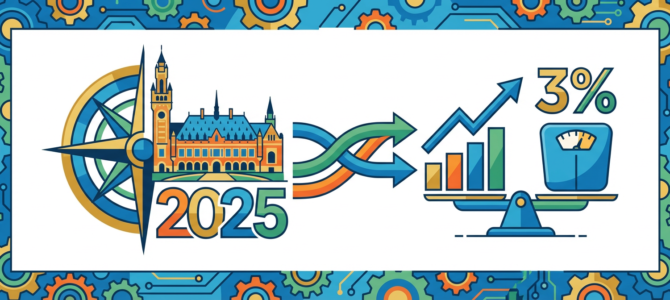
When NATO members gather in The Hague this June, they will not be debating whether burden-sharing matters. That ship sailed years ago. Instead, they will be wrestling with a harder question: what does fair look like when allies spend vastly different amounts protecting the same alliance? The centerpiece of these conversations will almost certainly be a proposal to raise the collective defense spending target from 2% of GDP to 3% across the board. This is not a trivial adjustment. It is a fundamental recalibration of what NATO members consider baseline responsibility.

To understand why this matters, follow the money backward. The United States currently accounts for roughly 68% of total NATO defense expenditure despite representing less than half of the alliance’s combined economic output. Let that sink in. One country is carrying more than two-thirds of the military burden for an alliance of 32 nations. That imbalance has been cited repeatedly in burden-sharing arguments, particularly by the Trump administration, and the numbers do not lie. When you see that ratio, you begin to understand why American policymakers keep raising this issue, and why European allies are finally beginning to listen.

The European Wake-Up Call
Here is what has genuinely shifted in recent years: European public opinion on defense spending has undergone a transformation that would have seemed impossible before Russia’s invasion of Ukraine. A February 2025 Pew Research Center survey found that majorities in most NATO European member states now support increased defense spending. This is a marked departure from pre-2022 polling, when many European publics viewed defense budgets as competitors to social spending rather than essential investments. That change in public sentiment is the foundation upon which governments can build political will to raise spending targets.
The data backs this up in concrete terms. As of 2024-2025, twenty-three of thirty-two NATO member states met or exceeded the 2% GDP pledge. Compare that to 2014, when the alliance formally adopted the pledge at the Wales Summit and only three members were hitting the target. That jump from three to twenty-three members in a single decade reflects years of American pressure, certainly, but also a genuine shift in how allies who share a continent with an increasingly aggressive Russia calculate the threat. When you live next to the problem, you do not need to be convinced that defense spending is necessary.
Poland and the Geography of Commitment
Poland offers the clearest example of how proximity to threat translates into spending commitment. The country leads NATO allies in defense spending at approximately 4% of GDP in 2025. Poland is not wealthy compared to Western European standards. It has less per-capita GDP than Germany or France. Yet it spends more as a share of its economy because the security calculus is different when Russia shares your border and Ukrainian cities are being shelled regularly. Poland’s defense spending enjoys broad domestic political consensus across party lines, which tells you something important about how existential threats can cut through normal partisan divisions.
This is where the conversation gets interesting from a political economy standpoint. Poland is not spending 4% of GDP because international organizations told it to. It is spending at that level because Polish voters and politicians across the ideological spectrum have concluded that their survival depends on it. If NATO members are being asked to move from 2% to 3%, the question becomes: will that target reflect genuine threat assessment, or will it become another aspirational number that only a handful of countries actually reach? The Hague Summit will be an opportunity to examine what drives real compliance versus symbolic commitment.
The Baseline Question Ahead
Formalizing 3% as the new baseline would mean a significant reallocation of resources across Europe. You can check current spending data and forecasts at NATO Defense Expenditure Data and Reports, which provides detailed breakdowns of member contributions and trends. What you will find is that most wealthy European NATO members still fall short of 3%, though several are moving in that direction. Germany, as the economic engine of Europe, would face particular pressure to increase spending substantially if 3% becomes the formal target. France, already spending near 1.9%, would need to adjust as well.
The political dynamics here matter as much as the economics. Governments that propose cutting social budgets to increase military spending face real domestic opposition. Yet the logic of collective defense is that everyone’s security depends on reasonable contribution from everyone else. This is not a novel insight, but it gets newly relevant when the threat environment shifts. Higher public support for defense spending across Europe, documented by Pew Research Center NATO and European Security Surveys, combined with Poland’s concrete example of sustained commitment, creates a political opening for serious discussion about raising baselines.
What Happens Next
The Hague Summit will not single-handedly resolve NATO’s burden-sharing tensions. These are structural issues rooted in geography, economic capacity, and differing threat perceptions. But it can formalize expectations and create benchmarks against which future performance can be measured. If 3% becomes the stated target, the real work begins: watching which countries move toward it, which countries explain why they cannot, and what pressures emerge to influence those choices. The money trail tells you where genuine commitment lies.
What makes this worth paying attention to is not the abstract principle of alliance responsibility, though that matters. It is worth watching because how NATO resolves burden-sharing affects your security, your economy, and the international order you will inhabit for years to come. Spend some time reviewing the data, comparing different countries’ spending levels against their economic capacity, and thinking through the logic of collective defense. These are not obscure technical questions. They are fundamentally about how groups of democracies make decisions together when stakes are high and resources are limited. If you want to understand modern geopolitics, this is where to look.