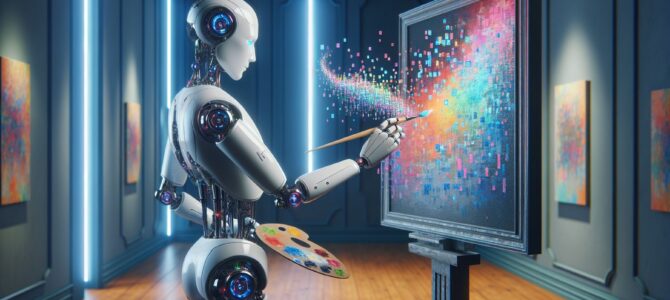
Hey fellow tech enthusiasts! Today, we’re diving into a realm that’s as thrilling as the edge of a black hole—exhilarating, a little mysterious, and definitely challenging the norms. I’m talking about Artificial Intelligence in the creative arts. Yep, you heard me right! Those machines are not just crunching numbers or optimizing your Netflix recommendations anymore; they’re out here writing sonnets and painting masterpieces. Let’s explore this fascinating crossover of silicon and creativity.
The AI Renaissance: Machines as Artists
What’s the first image that pops into your head when you think about creativity? Is it a splatter of paint on canvas, a haunting melody floating through a room, or perhaps a line of prose that stirs the soul? Now, imagine a computer doing all that! It’s not sci-fi anymore—it’s happening.
The Rise of AI-Generated Art
AI art is having its moment. Thanks to Generative Adversarial Networks (GANs), computers are crafting pieces of art that are being auctioned for millions. Remember when that AI-generated portrait “Portrait of Edmond de Belamy” sold for $432,500 at Christie’s? Yeah, my canvas and I felt a bit inferior that day too.
But what’s even more interesting is how these AI models learn art styles. They analyze thousands of artworks, taking inspiration, mixing styles, and eventually creating something that’s unique, if not a bit uncanny at times. The real kicker here? They’re just getting started. As these models get better, who knows, maybe the next Van Gogh isn’t a person at all.
Bard and Byte: AI in Literature
Let’s switch gears to another realm of creativity: literature. Now, we all know the struggle of writer’s block, staring at a blank page, praying for inspiration. Imagine a scenario where your friendly AI assistant pulls a Hemingway for you. OpenAI’s language model is already penning short stories and poetry. They even wrote an entire episode of “The Simpsons.”
Some folks are a bit worried about this. “Is AI going to take over the world and leave writers jobless?” they ask. Well, here’s my take: AI is a tool, not a replacement. It’ll handle the mundane bits—grammar checks, organizing ideas—so we humans can focus on the juicy stuff like emotions, context, and depth.
Creativity vs. Calculation: The Debate
Like any good story, there’s always some tension. One of the biggest debates out there is whether machines can truly be creative. Can complex algorithms and massive datasets equal the touch of a human soul?
Defining Creativity in a Digital Age
What is creativity, really? Is it just the ability to create something new and valuable? If so, does it matter if the creator is human or a hyper-advanced neural network trained on petabytes of data?
Critics argue that AI lacks emotions, context, and intuition—all essential components of genuine creativity. But here’s a question to ponder: can an emotionless creator still evoke emotions in its audience? Many say absolutely. AI is raising questions, changing perspectives, and in some cases, making us redefine creativity itself.
The Human Touch: Remaining Relevant
Here’s where it gets personal. With all the advances AI is making, there’s something raw, complex, and inherently human about creativity. An AI can generate a symphony, sure, but can it understand heartbreak and translate it into music that makes you cry? Perhaps one day, but not for now. And maybe that’s the point: instead of fearing AI, it’s about finding new ways to collaborate with these systems. After all, John Lennon didn’t write all by himself—he had Paul McCartney by his side. Consider AI as your virtual Paul.
Implications and Challenges: The Future of Creative AI
We’re standing at the dawn of a new era, folks. The convergence of AI and the arts offers limitless possibilities. Yet, like any innovation, it comes with its challenges and implications.
Copyright Chaos
AI redefining art and creativity comes with its own legal headaches. Who owns the rights to an AI-generated piece? Is it the programmer, the owner of the dataset, or the AI itself (which, FYI, isn’t legally possible under current laws)? Companies and lawmakers are still hashing this out, and it’ll be interesting to see what frameworks come into place.
Ethics and Authenticity
There’s another juicy topic swirling around: ethics. Is it ethical to use AI to churn out content that competes with human creators? There’s a potential for misuse, like flooding channels with AI-generated clutter or, worse, deepfake technology. Maintaining authenticity in the digital art realm matters, and platforms will need to develop methods to watermark or authenticate original content.
A New Renaissance?
Remember the Renaissance, when human creativity and innovation mixed to reshape societies? Some might say we’re at the cusp of a digital renaissance. The only difference? We’ll be collaborating with AI now, and if done right, it could lead to extraordinary creativity the likes of which we’ve never seen before.
Conclusion: Embracing the Future
I often imagine Michelangelo or Shakespeare squinting at a computer, trying to figure out what it means to upload creativity to the cloud. A technicolor world where art is not bounded by the artist’s mortal coil, but amplified by machine learning models that can churn out thousands of iterations in seconds.
The question isn’t whether AI will replace artists—honestly, who wants a melancholic robot sitting in your coffee shop? The important thing is how we’ll integrate AI into our creative processes and what new realms of expression this could open up. So my advice? Embrace it, play with it, and don’t forget to have fun along the way. It’s not the end of human creativity; it’s just a whole new playground.
And who knows, maybe one day we’ll attend an art gallery with masterpieces by both famous humans and a clever neural net named Mona Lisa 2.0. Now, wouldn’t that be something to talk about at dinner?
Till next time, keep painting with pixels, composing with code, and writing that AI-assisted epic novel. Cheers!