When Trade Policy Becomes a Hammer
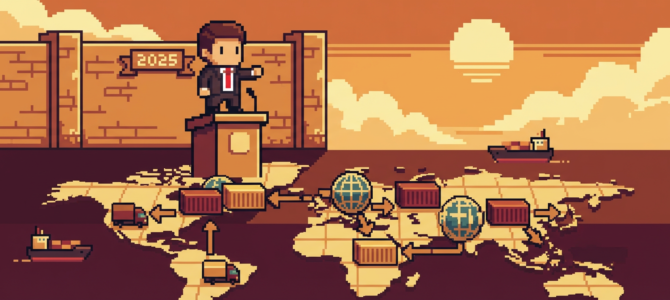
We are living through a genuine inflection point in global commerce. In April 2025, the Trump administration issued an executive order imposing a 10 percent universal baseline tariff on virtually all imports entering the United States. For those following trade policy closely, this figure alone warranted attention. But the real story was in the details: China faced targeted rates climbing to 145 percent at their peak, creating what amounts to a near-total trade barrier with America’s most significant economic rival. This is not incremental policy adjustment. This is a deliberate recalibration of how the world’s largest economy engages with international trade.

To understand what makes this moment distinctive, we need to reach back into American economic history. The last time the United States imposed tariffs at comparable levels was during the Great Depression, when the Smoot-Hawley Tariff of 1930 sent shockwaves through the global economy. By Q3 2025, according to analysis from the Peterson Institute for International Economics Trade Analysis, the effective average U.S. tariff rate had climbed to its highest level since 1934. We are not merely revisiting old debates about protectionism. We are entering territory that the post-World War II international order was specifically designed to prevent.

The Global Shock and the IMF’s Reckoning
Economic forecasters spend most of their time making incremental adjustments to projections. Occasionally, they must issue corrections that signal something has fundamentally shifted. In October 2025, the International Monetary Fund released its World Economic Outlook and revised global growth expectations downward to 2.8 percent for the year. The culprit was explicit: fragmentation in the U.S.-China trade relationship, alongside the cascading tariff escalations that followed the April executive order. This was not a minor downward tick. This was a meaningful deceleration in the growth trajectory of the entire global economy.
What makes this particularly significant is the mechanism at work. The IMF World Economic Outlook October 2025 analysis points to a world where trading partners are increasingly uncertain about market access. Businesses cannot plan long-term investments when tariff regimes might shift dramatically. Supply chains built around assumptions of relatively open trade face sudden recalculation. The cost is not merely the tariffs themselves, but the economic drag that comes from pervasive uncertainty. History shows us that this dynamic can persist for years.
Europe’s Nuclear Option and the Allies Strike Back
When one major economic power shifts its trade posture dramatically, others respond. By mid-2025, the European Union took a step it had never taken before: it activated its Anti-Coercion Instrument for the first time. This legal tool, created specifically to counter economic pressure from other states, targeted approximately 18 billion euros worth of American goods. The symbolic weight here matters as much as the dollar figure. Europe was signaling that it no longer viewed American trade policy as something to accommodate. It was responding as a strategic competitor.
Meanwhile, America’s closest neighbors pushed back too. Between May and September 2025, Canada and Mexico each invoked dispute settlement panels under the United States-Mexico-Canada Agreement over the administration’s steel and aluminum tariffs. Three separate arbitration cases wound through the system during this five-month period. These are not rhetorical complaints. These are formal legal challenges filed by trading partners who have been woven into American supply chains for decades. The fact that USMCA partners felt compelled to file such cases suggests they believed the tariff escalation violated the very agreement that bound their trade relationship together.
Historical Patterns and the Dangers of Precedent
Here is where the historical parallel gets instructive, though we must be careful about the limits of analogy. The Smoot-Hawley era ended not with triumphant American economic victory but with global contraction, retaliatory tariff spirals, and ultimately the Great Depression. That history does not guarantee we are headed toward that exact outcome today. Modern economies have different structures. Central banks have policy tools that did not exist in 1930. International institutions provide coordination mechanisms that were absent in that era. And yet. The basic logic remains: when major trading powers retreat from open commerce into protected blocs, the efficiency gains from specialization and comparative advantage disappear. The gains from trade evaporate.
The question facing policymakers, economists, and engaged citizens is whether this tariff escalation represents a sustainable new equilibrium or a transition to something worse. The 2025 data suggests the world’s major economies are betting on retaliation and counter-retaliation rather than negotiated resolution. The EU’s first use of its Anti-Coercion Instrument. Canadian and Mexican arbitration cases. Chinese retaliatory measures that we have not even fully catalogued here. These are not signs of a system stabilizing. They are signs of a system fragmenting.
The Work Ahead: Engaging With Trade Policy as Citizens
This is the moment when many people switch off from trade policy discussions, reasoning that tariff rates and dispute panels are too technical for ordinary civic engagement. I would argue the opposite. Trade policy shapes the price of goods you buy, the jobs available in your community, and the stability of the global order that has underwritten relative peace among major powers for eighty years. These are worth understanding.
Start by asking local questions. Which businesses in your area import goods affected by these tariffs? Which ones export? What are local employment patterns in sectors exposed to trade shocks? Your city council member and state representatives have opinions about trade policy, whether they have articulated them publicly or not. Their positions matter because they influence how your delegation votes on trade-related legislation in Congress. The tariff regimes of 2025 did not arrive without political choices. They can be modified or reversed through different political choices.
The scholarly consensus on Smoot-Hawley shifted decisively against it within a decade. Economists, business leaders, and policymakers came to view it as a catastrophic error. We do not know yet whether future analysts will view the 2025 tariff escalation the same way. But the outcome will be shaped by whether citizens engage actively with these questions or cede the entire discussion to specialists and politicians. What aspect of the 2025 trade situation concerns you most? Where do you see opportunities for your community to adapt? Those conversations matter now.